Friday, March 18, 2011

7. Sing You Home

When I got to Florida on Tuesday, I made sure to get the book I had carefully planned as this break's "fun reading" right away--Jodi Picoult's latest, Sing You Home. I've read all of her books (starting when I was 13 or 14), and they're really hit or miss for me lately. I couldn't pass this one up though with all the topics it promised to confront: homosexual relationships, adoption by a homosexual couple, the ethics surrounding embryo use, religious issues around those issues, alcoholism, and even the ideas behind music therapy--all things I'm interested in learning more about. One of my favorite things about reading fiction is the chance to learn about new things through an interesting, fast-paced plot, and my research of Picoult tells me she is quite well-researched.


It was not the most amazing book I have ever read. It was not even the most amazing Picoult book I have ever read. But it was thought provoking on a few levels. Without giving too much away, I'll list some of the "can you imagine's" that I found myself dealing with as I flipped through (so quickly, eating up the chance to read for fun) the novel.

Can you imagine...
...trying to get pregnant for nine years, only to have multiple miscarriages and a stillbirth?
...after those nine years your husband deciding he no longer wants to be a father? or even your wife?
...someone making a public case to say you should not have rights to frozen embryos containing your DNA, purely because of your chosen sexuality?
...someone questioning your abilities to be a good mother based solely on your sexuality?
...having the most painful secret about your past brought to light in a public setting as well as in front of all your family and friends?

I came up with many more "can you imagine" scenarios in my head, but I don't want to give too much away here at the risk of ruining the plot for anyone. Surely everyone's list of "fun reading" books are pretty long at this point, but I'd recommend this one because, at the very least, you can flip through it in two days (I'm living proof), and it's entertaining as well as thought provoking. In typical Picoult fashion, it's got your basic court scenes and plot surprises, as well as a list of well developed characters. As I said--worth reading even just for the issues it attempts to take on.

Monday, March 7, 2011

6. Re: Where are all the smart girls?

Recently, Anne blogged about an article called "The Trouble with Bright Girls" by Heidi Grant Halvorson and about why girls were recently found to be so much more likely to give up on a difficult task than boys. Anne summarizes the article, which explains: "this occurs because young girls are taught through early socialization that their abilities are innate and that, should they encounter a problem they can't immediately solves, they might as well give up; boys, on the other hand, are encouraged more frequently to learn through experience and power through failure, thus making them more resilient in the face of it in later instances." I, like Anne, sometimes wonder just how much it matters that women are beginning to outnumber men in academia and other positions if they aren't speaking up, but I'd like to offer an answer--it matters. To me, at least. Regardless of how true the stats from Halvorson's article are, regardless of how many women aren't speaking up because they are judging themselves too harshly or lack the confidence to completely display their intelligence and abilities, for each woman that does speak up, there's another out there proud of her and inspired at least in some small way to do the same thing for herself. For every mother that stands strong and confident in a world that still seems too often to be run by men, there's a daughter learning that she can do the same. I'll bet that's where that adorable five-year-old learned to be so sure of herself.

Anne makes a good point. Too many women at Notre Dame and too many women everywhere are reluctant to admit to their own intelligence, and I'm guilty of being a part of that group at times. But just to cap off my soapbox speech I've started to make a little here, I'll close with this. Little by little, we're getting better at recognizing that we as women know we can make a difference and we know we're powerful. You wouldn't have seen that little girl ten years ago--and not just because there weren't as many cute kids on youtube. We're making progress. We just can't be afraid to realize that, stand up for ourselves, and not be afraid to be a little full of ourselves, if the situation warrants it.

Wednesday, March 2, 2011

Just a Sidenote

Today I was cleaning my betta fish's bowl, and I always worry about it because she gets all uncomfortable looking while she explores the new water and rocks. I caught myself saying to my roommate, "It's so hard to do what you have to do to keep them safe when they seem so sad about it." She laughed at me for "being a mom."

Tuesday, March 1, 2011

5. A Hometown Momstrosity

I can't believe it's taken me this long to blog about this, but honestly, it makes me so sad that this story took place in my small hometown outside of Detroit that it probably explains a little of why I've stayed away from it. However, today I wondered what progress had been made in this case, and I decided I could fill anyone reading this in on it as well.

Last semester, I read a very disturbing story online that unfortunately happened just a few blocks from my parent's house in Trenton, MI. A 33 year old woman named Jennifer Petkov had been taunting her neighbor, a seven year old girl named Kathleen Edward. If taunting a seven year old girl does not seem problematic enough, Kathleen had also been diagnosed with and in the late stages of Huntington's disease. Jennifer posted pictures of Kathleen's mother who had died of the same disease on Facebook, edited together with pictures of the grim reaper, and had also posted pictures of Kathleen herself edited with a skull and cross bones. Jennifer admitted to the taunting, and explained that at its root was a feud among the families, specifically she and one of Kathleen's caretakers, her grandmother. The feud reportedly started from something so small as who was or was not invited to a child's birthday party, and has somehow progressed to this.

The incident was not Jennifer's last appearance in the news. Since, she has also plead guilty to battery and assault for her attempts to run over a different neighbor with her car.

When I was thinking about it today, I came across this article which explains that Jennifer has been ordered to move out of her home and sentenced to eighteen months probation as well as many different evaluations.

I am glad to see that action is being taken against Jennifer Petkov, and especially that she has been given a restraining order so that Kathleen can continue her life in peace. I think one of the things that bothers me most about this story is that Jennifer is a mother herself--I can only imagine growing up in a household with Jennifer as a mother. I cannot understand how anyone can have so little compassion as to actually taunt a young, dying girl, but I think the part that makes me so sick about this story is that Jennifer has her own children as well. Furthermore, the fact that part of Kathleen's tragic story includes losing her own mother and Jennifer did not hesitate in attacking that as well makes the story all the more horrifying.

Friday, February 18, 2011

4. [Lack of] Nurture in Dahl's Matilda

In working through my ideas for my essay for Monday, I was thinking back through the different levels of nurturing the mothers (or mother figures) we've read so far and the results the different levels of nurturing produced. In Frankenstein, for instance, a possible reason the creature becomes so out of control is the lack of nurture or companionship Victor is willing to give him. Similarly, one stance on why Ben in Doris Lessing's The Fifth Child is the way he is comes from the way his parents reject him in many ways immediately following his birth. Even in Patricia Powell's Me Dying Trial, arguably many of the children struggle in part because of Gwennie's inability to be there for them throughout much of their childhood.

This got me thinking about examples of children who lack nurture growing up that we see in pop culture, which quickly led me to think about one of my favorite books/movies from my childhood: Matilda.


Matilda stands as a very definite example of a child who lacks any nurture or companionship from her parents. However, in Roald Dahl's story, Matilda is somehow able to find the nurture she needs first as a very small child in books and as a bit of an introvert, and eventually Miss Honey steps in as her mother figure.1 I suppose I am just looking (or maybe stretching is a better word here) for examples of children who do not seem damaged from a lack of nurturing mother figures. Is Dahl's story too romanticized? Essentially, it is similar to Me Dying Trial, in which Peppy rises above a troubled childhood with a less than nurturing mother to become valedictorian of her high school class. To some degree, both of these young female characters seem to speak volumes for the nature side of the debate. Unfortunately, this just makes explaining the behaviors of Victor's creation and Ben all the more confusing.


1Dahl, Roald. Matilda. Ed. Quentin Blake. New York: Puffin, 2004. Print.

Wednesday, February 16, 2011

3. The Fifth Child - Another Frankenstein?


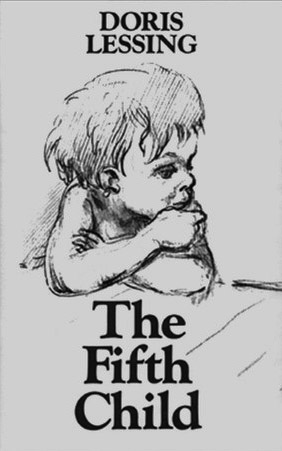
I think this is a very interesting cover image for Doris Lessing's The Fifth Child,. It is not the cover I have, but this one, mine, and many of the covers I found images of display Ben or "the fifth child" as a relatively cute toddler rather than as the monster he is always described as in the book. I'm interested in why the editor of those versions chose not to go with a more... controversial? cover, like this one:


One of the reviews on the back of The Fifth Childcalls it "a moral fable of the genre that includes Mary Shelley's Frankenstein."1 While I wouldn't necessarily go so far as to place this on the literary level of Frankenstein, I agree that it fits into the genre the earlier novel set. There are certainly very distinct similarities to Frankenstein's creation sprinkled throughout the work that makes me wonder how much Lessing took from Shelley. For instance, like Frankenstein, when Ben is born, he is described as "muscular, yellowish, long" (48). Much later, toward the end of the book, it almost seems as if Harriet is implying that Ben is some sort of descendant somehow from Shelley's creature himself. She questions: "How do we know what kinds of people--races, I mean--creatures different from us, have lived on this planet?" (106). Harriet explains that she thinks Ben is one of these nonhuman creatures, and somehow a descendent of these creatures. What I suppose was another standout connection to Shelley's novel for me was the trouble both Victor and Harriet had with admitting that they had had a part in bringing these creatures into the world, and the way they had both essentially abandoned a loving relationship with the "newborns" from the very start of their lives, even though they had been initially responsible for the birth. It seems to me a lot of blame lies with both Victor and Harriet, but that their situations also warrant an exploration of nature vs. nurture.


1 Lessing, Doris May. The Fifth Child. New York: Vintage, 1989. Print.

Friday, February 4, 2011

2. "The Online Mom"

I stumbled upon this blog in an...interesting way. LinkedIn emailed me and asked, "Have you Googled yourself?" and I thought to myself...not recently. So I did. My recent USA TODAY College Blog came up, and then a blog entry about it on The Online Mom. After reading through the entry about my blog, I decided to explore the rest of the site.

The site markets itself as "Tech Tools for Parents," so most of it is based around the internet, phone, video games, etc. and how to use those tools either as a parent or how to use incorporate them into your children's lives. They discuss the ways you can "protect your children" from problems that arise from this generations fascination with the internet and other technology and also debate issues of what is appropriate for children of which ages. One of the recent posts that I found really interesting was actually somewhat in opposition to my Facebook blog--it was a post about why you should let your children set up a Facebook profile. Essentially, they discussed the number of "teachable moments" available to parents for their children via Facebook, and I found that to be a really interesting perspective. Check out the whole post here.